The letters from Tatjana


Translator's Note: This is a machine-assisted translation completed on March 27, 2026. While care has been taken to maintain accuracy, this translation has not yet undergone human review or validation. Please note that specialized terms, historical references, and nuanced content may benefit from expert review.
Pronouns
Flekkefjord Municipality, which serves as the heir to Gulbrandsen’s life’s work, refers to the artist using he. Filmmaker Steffan Strandberg, who portrayed Gulbrandsen in the documentary Seventh Heaven, uses she. Since it is not possible to ask Gulbrandsen directly about preferred pronouns, we employ they here.
The artist at Hidra
Tatjana Lars Kristian Gulbrandsen grew up in Oslo’s affluent western districts, but the family spent their summers on the island of Hidra outside Flekkefjord. Gulbrandsen moved there as well after completing an art education in 1968. The house, which was given the name Gloarbu, was designed by Gulbrandsen. It was a home filled to the brim with books, colours, and objects—art installations created from household waste.
Gulbrandsen received their education at the Norwegian National Academy of Craft and Art Industry, where they studied for 11 years, from 1949 to 1960. They began in the goldsmithing programme, then continued in printmaking and enamelling. Later, they undertook periods of study at the Royal College of Art in London.
Gulbrandsen is known for dramatic, non-figurative paintings characterised by strong colours. The Vest-Agder Museum describes the art in the following way:
The energy in the artworks gives them an optimistic radiance. The artist presents a wondrous world to the viewer. As in every fairy-tale world, it contains both dark elements and their opposites. The paradisiacal aspects outshine any resistance and pain the paintings might otherwise contain.
Gulbrandsen’s works are represented, among others, in the collections of the Arts Council Norway, the Sørlandet Art Museum, the National Library in Paris, St. Olaf College in the United States, Queen Sonja’s art collection, and the Pope’s collection in Rome.
Seventh Heaven
From as early as 1968, Gulbrandsen began alternating with their alter ego, Tatjana. With short skirts, a bare midriff, and household paint on their face, Tatjana stood out from almost everyone else. In 2003, Steffan Sandberg produced the documentary Seventh Heaven, which portrays Tatjana Lars Kristian’s life and artistic practice as it unfolded within a small, conservative local community. While Lars Kristian is 75 years old, the alter ego is a 23‑year‑old girl. The artist transcends both age and gender.
The letter collection
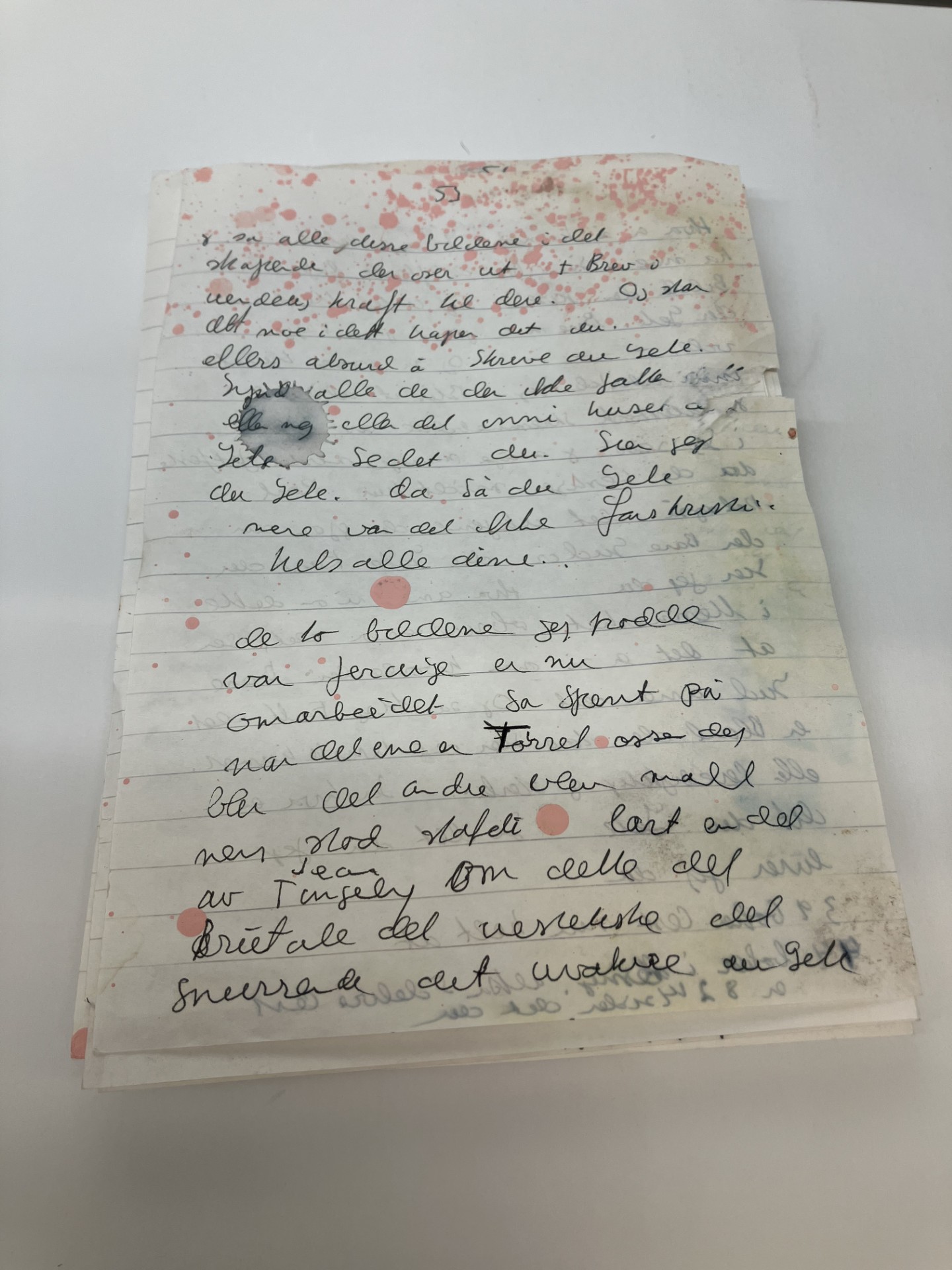
Back in the archive premises. Opening these cardboard boxes is like peeking into a treasure chest. The envelopes overflow with pages. The letters are long and substantial—thirty pages, sixty, a hundred… The recipient is Else Margrethe Sand. She was a close friend of Gulbrandsen, and the letters constitute a warm declaration of love to her.
In interviews, Gulbrandsen could appear humorous and playful—but in the letters, different facets emerge. They write about faith and doubt, about belonging and loneliness. The pages are filled with powerful emotions. Illustrations accompany the text, and in some places the sheets bear traces of brightly coloured paint.
In the film, we travel from our safe reality into the soul of Lars Kristian, the description of Seventh Heaven states. Entering these letters feels much the same.
Tatjana's testament
Gulbrandsen bequeathed their life’s work and property to Flekkefjord Municipality in 1987, on the condition that the municipality commit to establishing a venue for the display of their work. The municipality has entered into a collaboration with the Flekkefjord Art Society, and in 2021 Galleri Gulbrandsen opened its doors, welcoming visitors every Saturday.
The International Library of Fashion Research (ILFR), an international research centre for visual and material culture located at the National Museum in Oslo, also highlights Gulbrandsen’s work. Tatjana’s photographs are set to receive a dedicated place in ILFR’s permanent collection, as an important part of Norwegian fashion history and queer cultural history.
At the Queer Archive, we are proud and grateful that this unique collection of letters has become part of our holdings. The material is currently being digitised, and we look forward to making it available to students and researchers.
The article was first published in På Høyden on 22 March 2026.
Kilder:
SKA/A-0204 Gulbrandsen, Tatjana Lars Kristian Gulbrandsens archive in Skeivt arkiv.
Lars Kristian Gulbrandsen, Store norske leksikon, snl.no
Egen fil i Flekkefjord. Blikk.no 17.09.2023
Lars Kristian Tatjana Gulbrandsen. Vest-Agder-museet, read 27.03.2026.
Skeiv kunst bevares – Mange kan kjenne seg igjen. nrk.no 04.11.2025
Mitt møte med Lars Kristian Gulbrandsen. Stein Thorud, Norske kunstforeninger.Lest 27.03.2026.
Dokumentarfilmen 7. himmel. Filmarkivet, lest 27.03.2026