In 2025, Skeivt arkiv celebrated its first 10 years!
Translator's Note: This is a machine-assisted translation completed on December 19, 2025. While care has been taken to maintain accuracy, this translation has not yet undergone human review or validation. Please note that specialized terms, historical references, and nuanced content may benefit from expert review.
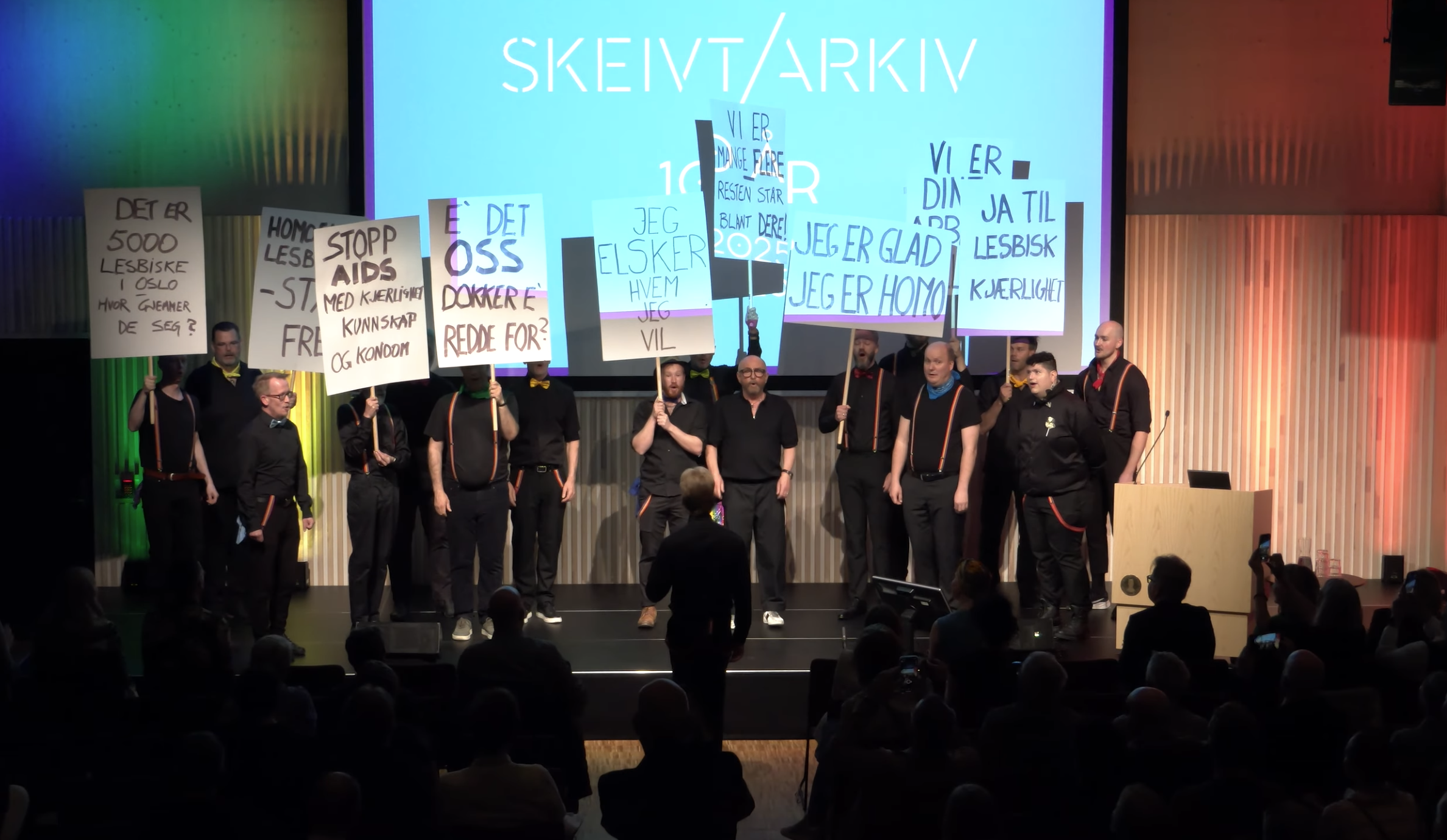
As per tradition, we sum up the past year already in December, while wishing everyone a joyful holiday season and a happy New Year. The highlight of the year was without doubt the celebration of our anniversary, which took place on May 15 in the University of Bergen’s new grand venue, Nygårdsgaten 5. Minister of Culture and Equality Lubna Jaffery and UiB Rector Margareth Hagen were among the honored guests. Together with a packed audience, they enjoyed highlights from the archive’s first ten years. Here is a link to the full anniversary event: Skeivt arkiv celebrates its first ten years.
Årets privatarkiv 2025. Fv: Herman Birkeland Krohn-Dale (Skeivt arkiv), Kathy Lie (juryleder) og Runar Jordåen (Skeivt arkiv).
Archive of the Year
Another highlight was being named “Private Archive of the Year” during the Private Archives Conference in Stavanger in May, by a jury chaired by Kathy Lie (SV). This is a great honor – we see it as recognition that the work we do is important – and we are especially pleased to receive such acknowledgment from the Norwegian archival community. At the same conference, Bjørn Andre Widvey interviewed Colleen J. Shogan, who in February was appointed as the Archivist of the United States by the American president.
We have also received a number of new archives – both physical and digital – including collections from FRI Nordland, Leif Pareli, Tatjana Lars Kristian Gulbrandsen, and Luca Dalen Espseth.
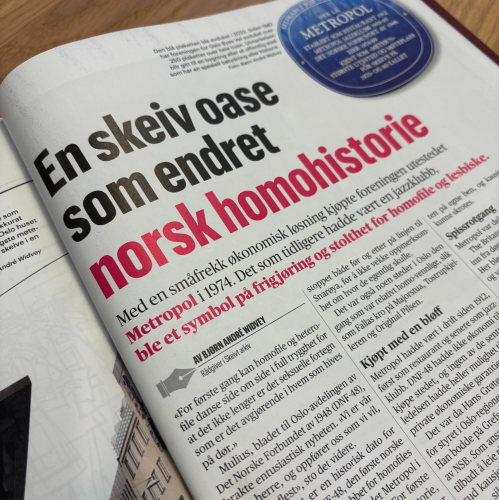
When it comes to outreach, we have also had a busy year, contributing articles to Aftenposten Historie, taking part in an exhibition during Bergen Assembly, and participating in numerous events during Pride and in other contexts. We joined a research project on queer experiences during the war and co-organized a major day seminar on the topic at the House of Literature in Oslo.
Project staff member Silje Teigland Røstøen has organized a large part of the archive of the Norwegian National Association for Lesbian and Gay Liberation (LLH) as part of the “FRI-2022” project. In addition, she has organized several smaller archives included in the research project “The History of the Queer Movement.”
The year has been marked by high activity and many requests to access archival material. We have been contacted by numerous students, journalists, researchers, and authors interested in topics such as the history of DNF-48, queer history in Trøndelag, and queer female poets. We are also frequently asked for advice by journalists and students on various projects, outreach assignments, and potential collaborations. It is clear that Skeivt arkiv has a broad scope as the only cultural heritage institution in the country dedicated to this field! This has resulted in a very high level of visibility, but there are limits to what an institution with six staff members can accomplish.
Economy
This year, we have once again worked toward an increase in our operating funds. Although both Rødt and SV proposed an increase for us in their alternative state budgets, we did not succeed this year either. Our goal now is to work toward the state budget for 2027, and we are pleased that an increase in Skeivt arkiv’s operating funds is included in UiB’s budget application. We have also applied for support from Oslo Municipality and Vestland County Municipality, as Skeivt arkiv has had significant activity in these regions. These applications were also unsuccessful.
At the very end of the year, however, we received good news: we have been awarded NOK 240,000 in archive development funds from the National Archives! This will allow us to launch our project to develop and test new methods for digital archive management.
Below, you can read more details about what we have worked on within archives, the life story collection, research, teaching, outreach, library, networking, social media, staffing, and a brief overview of Skeivt arkiv in the media.
Thank you!
A heartfelt thank you to everyone who has donated archives to us, invited us to their events or participated in ours, and to those who have used our collection; thanks to partners, supporters, colleagues, and followers! Collecting, documenting, and sharing queer history is incredibly exciting, and the engagement we encounter gives us energy and inspiration to continue this important work.
In 2025, Skeivt arkiv received 30 accessions/additions. The transfers amount to a total of 19.7 shelf meters, in addition to approximately 164 GB of digitally born material. During the year, Skeivt arkiv expanded with nine completely new archives.
Of the additions registered as separate archives or as parts of existing archives, six were delivered by various organizations/institutions, while 24 came from private individuals. Several of the accessions/additions were delivered by the same actor/person. Some additions consist exclusively of material that naturally belongs in Skeivt arkiv’s established collections of books, journals, and individual items, among others.
Skeivt arkiv has received archival material from, among others, FRI Nordland and SLM Oslo. We have also received exciting archival material created by private individuals such as Leif Pareli and Tatjana Lars Kristian Gulbrandsen. The material contains important documentation from key actors, both individuals and organizations. It includes records of organizational activities and private letters. Documents depict personal lives and activities. Various objects accompanying the archives provide supplementary information.
We have focused on acquiring digitally born archives from several actors. Agreements have been made with, among others, FRI and Skeiv Ungdom, to eventually preserve their digital archives. Going forward, we hope that more will allow us to assist with the management and preservation of their digitally born material.
Archival Arrangement
We have organized and completed the archives of Helge Hasselgreen, Erik Harrison, Birgit Bjerck, Terje Bratberg, Dag Strand Nielsen, Kjell Erik Øie, Steinar Bergh, and Jofrid Burheim. Most of these archives are now available on Arkivportalen.
Current projects include the archives of Jon Gunnar Arntzen, Tatjana Lars Kristian Gulbrandsen, Svein Skeid, Blikk, Stein Wolff Frydenlund, and the archive of LLH, where a significant portion of the material has now been arranged, described, and made searchable on Arkivportalen. In addition, we are working on the “Queer Life Stories” archive, where we register and describe interviews from our life story project. This archive is regularly (re)published on Arkivportalen.
With the assistance of conservators from the Special Collections Section, conservation work has been carried out on two archives: John Gunnar Arntzen and Tatjana Lars Kristian Gulbrandsen.
Digitization
Over the past year, our focus has been on increasing digitization output—and we have succeeded. The two largest projects have been digitizing our Norwegian journals (more on this below) and completing the digitization of the photo archives for the journals Blikk and Løvetann.
Our collection also contains large amounts of digital material stored on USB drives, CDs, and floppy disks. These have a limited lifespan and hold a wealth of unique sources. We have worked to future-proof this material by making it readable on modern machines and preserving it on secure servers. As part of this effort, we have developed routines for such work in collaboration with other units in the Special Collections.
Throughout the year, Skeivt arkiv’s website has undergone several improvements to ensure better security. Large parts of the site have also been translated into English, which has led to increased activity from abroad. We have published several new articles on Skeivopedia, cleaned up subject terms and metadata, and are actively working on better solutions for presenting the archives.
We make a large portion of the collection that can be freely viewed available on our website. The display of our collections is built on the same technology as the presentation solution used by our sister archives in the Special Collections—Billedsamlingen and the Manuscript and Rare Books Collection—through Marcus.
Skeivt arkiv is also part of Digispes, a cross-unit group within the Special Collections that addresses shared challenges. Topics such as website development and the further development of Marcus are discussed here, and we present projects and solutions that can inspire future improvements in digital dissemination.
On Skeivt arkiv’s initiative, the National Archives have also made more of the archive of Det norske forbundet av 1948 available. This includes material related to the international engagement of the Norwegian gay movement in the 1950s, now accessible through Digitalarkivet.
Bastian Danielsen med lydruller og annet som er digitalisert.
Cultural Heritage and Analog Media
The National Library’s major Cultural Heritage Project has been extremely valuable for Skeivt arkiv. After we sent a large number of cassettes, audio reels, and videotapes to Mo i Rana for digitization, we received everything back this spring as audio and video files. This material has proven to contain a wealth of fascinating documentation that we will benefit greatly from. Many thanks to the National Library for unlocking this treasure chest for us.
Use of the Archive
We receive many inquiries about access to and use of archival material, particularly from students, researchers, and journalists. This year, the archives of HivNorge, Kim Friele, Stein Wolff Frydenlund, Dermot Mack, Dag Strand Nielsen, and Rolf Løvaas have been especially in demand. We also receive a number of requests to view the life story interviews.
Documentation Work
In addition to preserving archives, we have continued in 2025 to work on documenting queer history in other ways. The project to collect information about women couples who lived together before 1970 has continued.
Finally, in 2025 we gathered information about the women who served on the board of the gay movement in the 1950s and 1960s. Heidi Rohde Rafto has put in significant effort on this work.
Another example is the effort to collect sources and information related to the life and work of Alf Martin Jæger, which this year also included an interview.
It is particularly critical to collect information about people and events while there are still living witnesses, and this type of documentation work will remain a priority in 2026.
Life Story Interviews and Oral History
In 2025, we conducted nine new interviews for our life story collection. This is slightly fewer than in 2024. All interviews were carried out in the Østlandet region. We interviewed four men, three women, and two trans persons. The collection now includes approximately 230 individuals in total.
2024 was the year when all recordings in the Life Story Collection were transcribed. This milestone was made possible by a new AI tool launched by the National Library in February. NB Whisper is a language model for transcribing Norwegian, based on OpenAI’s Whisper. The next goal is to make the Life Story Collection more accessible to the archive’s staff through the use of RAG (retrieval-augmented generation).
Oral history and the Life Story Collection were also featured at the Nordic Archives Days in September, where we gave a presentation titled “New Voices in The Archive.” We also participated in a panel discussion on promoting greater diversity in archival collections across the Nordic countries.
We took part in this year’s Memoar Conference, a professional conference on oral history, where we contributed as a moderator in a panel discussion on oral history as a safeguard for democracy.
Literature
Skeivt arkiv’s collections of books and journals continue to grow through donations and our own acquisitions. In addition to receiving books, journals, and other printed materials as donations, we also purchase antiquarian books and new scholarly literature.
Skeivt arkiv holds the most complete collection of queer journals in Norway. Many of these journals have arrived as part of archives mixed with other materials, which meant we lacked a proper overview. Over the past year, we have digitized 427 journals since January 1, which means that most of the Norwegian journals in our collection are now digitized. We now have a clearer understanding of our holdings and can share them more easily. An overview of the Norwegian journals can be found here.
New scholarly literature relevant to queer history is purchased and made available for loan. It is encouraging to see that new publications on Norwegian queer history continue to appear! Examples from the past year include the collection of Petronelle Nielsen’s diary notes, Der bor en lengsel i sjelen – Petronelle Nielsens dagbøker og reiseskildringer 1824–1860, edited by Kaja Schjerven Mollerin, and Anna Nafstad’s biography of Alfhild Hovdan: Fra Kristiania til Oslo: En reise gjennom Alfhild Hovdans liv.
Research
Skeivt arkiv is involved in two major research projects: The History of the Queer Movement is a project initiated by Skeivt arkiv in collaboration with the Department of Archaeology, History, Cultural Studies and Religion (AHKR) at the University of Bergen. Progress in the project has been somewhat delayed over the past year due to staffing issues, but significant work has been done to prepare and process sources that are essential for the project (see introduction above).
Ordinary Lives and Marginal Intimacies in Rural Regions. Contrasting Cultural Histories of Queer Domesticities in Norway, ca. 1842–1972 (Queerdom) is another project at AHKR in which Skeivt arkiv actively participates. As part of this project, Skeivt arkiv attended the European Social History Conference in Leiden, where Jordåen gave a presentation: “What Resembles the Dark Past Shall Soon Disappear: A Northern Norwegian Approach to Homosexuality and Minority Politics in the 1920s.”
Two of the archive’s staff members also attended the conference Queer Pasts: What’s Queer in Queer History? in Copenhagen.
Skeivt arkiv is also actively involved in the research group Expert Knowledge and Everyday Knowledge at AHKR and in the interdisciplinary research group SkeivForsk at UiB. Skeivt arkiv contributes both through its own research and as an infrastructure for research on queer history.
Runar Jordåen has also worked on a project about queer lives during the occupation together with Maria Fritsche (NTNU), Hans Wiggo Kristiansen (OsloMet), and Camilla Maartmann (Grinimuseet, MiA). The project reached a preliminary conclusion in October with the publication of three articles on the topic in Historisk tidsskrift 3/2025. The project was presented at a well-attended event during Oslo Pride, and in November Skeivt arkiv co-organized a seminar hosted by Museene i Akershus/Grinimuseet at Litteraturhuset in Oslo: “Between Prosecution and Precarious Tolerance: New Research on Queer Lives During and After the War.” The entire seminar was filmed by Jo Hjelle from Skeivt arkiv and is available here: Homoseksualitet i et okkupert Norge | Skeivt arkiv.
The collaboration has been highly fruitful, and we look forward to continuing it in 2026.
Skeivt arkiv also participates in a project on queer Sámi history led by Associate Professor Elisabeth Stubberud at NTNU, commissioned by the Norwegian Directorate for Children, Youth and Family Affairs.
Jordåen also attended the seminar “Leben und Lieben in Zeiten des Hasses” in Vienna on March 9. This event brought together researchers from Norway and Austria who have studied the life and diaries of Ruth Maier. Jordåen gave a lecture titled: “Queere Geschichte Norwegens – eine kurze Einführung.”
In addition to these activities, Skeivt arkiv’s research expertise has been central to oral dissemination and to many of the popular science articles published over the past year. It has also played a key role in teaching, advising students, and outreach work.
Besøk av studenter fra St. Olaf College i Minnesota.
Teaching and Student Guidance
In 2025, Skeivt arkiv continued to contribute to teaching and advising students. On January 24, we hosted a visit from students from St. Olaf College in Minnesota. Three days later, we organized a queer historical city walk for students in Cultural Studies (KUVI 101), and on February 6 we gave a presentation for students in Art History.
Skeivt arkiv also contributes to the new course Digitization of Cultural Heritage (AHKR). On March 18, Bjørn Andre Widvey, Ragnhild Bjelland, and Herman Birkeland Krohn-Dale led a full day of presentations on Skeivt arkiv, ASTA and Arkivportalen, and on digitization and digitally born archives.
On April 8, we participated in teaching for the course Scandinavian Literature – 20th and 21st Century Scandinavian Area Studies (SAS2B).
On September 2, Runar Jordåen gave a lecture on Skeivt arkiv and queer history in the course Introduction to Cultural Studies (KUVI 100).
We have also received many inquiries this year from students at various universities who wish to write master’s theses on queer history. Skeivt arkiv has provided advice and guidance on which projects are feasible, considering the available documentation and archival material at Skeivt arkiv and other archives and institutions.
Henrik Fuglesang was an intern with us this spring through the course AHKR 201.
This year, a master’s scholarship was again announced to encourage student projects on queer history. For the first time since the scholarship was established, none of the applicants met the criteria for the award.
Runar Jordåen i panel sammen med Mark Gevisser på arrangementet “Å skape skeiv historie” under Littfest Bergen.
Outreach
In 2025, we continued to contribute articles to Aftenposten Historie—four in total. The journal will have a new editor in 2026, but we have agreed to continue the collaboration and provide articles next year as well.
An important part of Skeivt arkiv’s outreach work has been welcoming groups and individuals who wish to learn about the archive and receive a guided tour of the collections. This form of engagement allows us to provide a close and tangible picture of our work.
In January, we hosted guided tours for Nynorsk kultursentrum and for KODE: Museum of Art, Design and Music in Bergen. On February 3, Bergen Center for Electronic Art visited us, and three days later we welcomed author Mark Gevisser from South Africa, the writer of The Pink Line.
During the year, we held similar tours for a research group from Western Norway University of Applied Sciences (April 10), for Blikk editor Aslaug Olette Klausen (May 15), and for the Sámi Archives (May 19). In June, we welcomed Helge Ytterøy L’orange, leader of the LGBT+ network of the European center-right alliance European People’s Party, as well as researchers and visiting scholars from the Centre for Women’s and Gender Research at UiB. Other notable visits included Heidi Kurvinen, Professor of Gender History at UiB, and Glyn Davis, Professor of Film Studies at St Andrews College in Scotland, who stopped by in September.
In addition to these tours, Skeivt arkiv also had an extensive program of lectures and other forms of participation in events throughout 2025 (for purely educational events, see the section above).
Glyn Davies besøker arkivet. (Runar Jordåen, fung. faglig leder tv)
On February 7, Runar Jordåen took part in a panel discussion with Mark Gevisser at the event “Creating Queer History” during Littfest Bergen (in collaboration with SKOK). Jordåen also participated in March and April in a seminar in Vienna and presented a conference paper in Leiden—see more on this above under Research.
On April 28–29, we also attended this year’s Private Archives Conference organized by the Norwegian Archive Association. Bjørn Andre Widvey led a conversation with Colleen J. Shogan, who served as the Archivist of the United States until she was dismissed by the president in February this year.
We also gave a presentation at the national Photo Network’s spring meeting on May 5, where the topic was ethically problematic photographic material and cataloging work.
On May 9, Widvey participated digitally with a presentation at Aasentunet in Ørsta during Bygdepride.
On May 15, we hosted a major 10th anniversary celebration in the University’s Grand Hall. (The event can be experienced or revisited here.) Over 150 people attended, including Minister of Culture and Equality Lubna Jaffery, National Archivist Inga Bolstad, Secretary General of Skeiv Verden Hanne Lyseth, UiB Rector Margareth Hagen, and Kjetil Landrog from the Norwegian Archive Association.
Professor Tone Hellesund received special recognition and thanks for her work in establishing the archive in 2015. Three master’s students—Emilie Lekve, Janny Sjåholm, and Birger Berge—shared their experiences collaborating with the archive. Veteran activist Leif Pareli also gave a heartfelt speech in support of the archive. The choir Rainbros performed, and Linda Eide entertained the audience with a humorous talk to great delight.
During Bergen Pride (Regnbuedagene) in June, we organized a book talk with Siri Sunde. In addition, we gave an introduction on the history of the rainbow flag ahead of a debate about its use. We were also invited to PwC in Bergen for their breakfast event during Pride, where we contributed with a presentation on the history of the rainbow flag. Runar Jordåen and Tone Hellesund also led queer history city walks through Bergen on June 16 and 18.
We took part in a number of events during Oslo Pride as well: we participated in and organized several panel discussions, including a book talk with Siri Sunde. We were also central to a queer city walk organized by Oslo Museum.
On June 22, Runar Jordåen gave a presentation titled “§213 under the Occupation” at the seminar “Young and Queer under German Occupation.”
Skeivt arkiv also hosted its own event, “75 Years of Organized Gay Activism,” at Pride House. Bjørn Andre Widvey moderated a panel discussion with Runar Jordåen, Siri Lindstad, and Vigdis Bunkholdt. Jo Hjelle filmed the event.
On June 24, Skeivt arkiv, represented by Herman Birkeland Krohn-Dale, participated in a panel discussion during Kulturytring in Drammen. The discussion focused on how different actors collect stories and materials from individuals.
On August 12, we took part in an event organized by the Arkivet Peace and Human Rights Center during Arendalsuka: “Civil Preparedness and Minority Expertise in Emergency Preparedness Work.” Bjørn Andre Widvey contributed with a presentation and as a panel participant.
At the beginning of September, Jordåen gave a presentation on queer history for academic advisors and HR staff at the Faculty of Science and Technology (NT) at UiB. On September 16, Bjørn Andre Widvey attended the Nordic Archives Days in Oslo, where he gave a talk and participated in a panel on oral history collection. Three days later, he moderated a book talk with Tone Vik, author of Fra dude til diva, about her journey from man to woman.
The play Star XVI was performed in Haugesund on September 21 and in Bergen four days later. The production is the result of a Norwegian–Icelandic cultural collaboration between Skeivt arkiv (represented by Bjørn Andre Widvey), Scenekraft in Haugesund, and Handbendi in Iceland. This collaboration led to the performance of Star XVI, a fictional story about identity based on material from the archive. A guest performance in Iceland is planned for 2026.
At the beginning of October, we gave presentations for students from Western Norway University of Applied Sciences and for a group from the Norwegian Union of Municipal and General Employees. On October 21, we participated in a panel discussion about the film Peter Hujar’s Day during the Bergen International Film Festival (BIFF).
On November 4, Runar Jordåen gave the lecture “Why Queer History – Queer Lives and the Struggle for Rights in Fair and Foul Weather” at Rosa Kompetanse’s 2025 network seminar. On November 11, we hosted a book talk led by Bjørn Andre Widvey on Ketil Slagstad’s book Standardizing Sex: A History of Trans Medicine. On November 20, Runar gave a presentation on §213 at the event “Young and Queer under German Occupation” at OsloMet. The following day, Skeivt arkiv co-organized the seminar “Between Prosecution and Precarious Tolerance” (see more on this in the introduction). In November, Herman Birkeland Krohn-Dale also gave a presentation at an event organized by PKI Vest during Transgender Awareness Week.
Throughout the year, we have received many requests to provide images, facts, and other information to the media—whether for articles, interviews, or research purposes. This year, we have particularly contributed to a planned series about Henki Hauge Karlsen.
During the year, 27 new articles have been produced and published on the online encyclopedia Skeivopedia.
Collaboration and Networks
In 2025, we continued to build and maintain networks with various cultural heritage institutions through meetings, events, and research projects. The collaboration with Grinimuseet / Museene i Akershus deserves special mention.
We are part of the network Privatarkiv på Vestlandet and the national Private Archives Network. Skeivt arkiv participates in the reference group for the preservation plan for private archives in Vestland County. We maintain close collaboration with archival communities both locally in Bergen and nationally, and the Norwegian Archive Association has been an especially important partner.
We also take part in the Nordic collaborative project for queer archives (NNAQH), which has included several digital meetings as well as an in-person meeting in Copenhagen in May.
In connection with the conference in Leiden in March, Runar Jordåen and Line Førre Grønstad visited IHLIA LGBTI Heritage, our sister archive in Amsterdam. During a vacation in July, Runar Jordåen also visited the Swiss gay archive in Zurich.
It is important for Skeivt arkiv to maintain close ties with others working on queer archives internationally. This is a growing field with significant interest from students, researchers, and the general public, but in many places, archives are poorly funded and sometimes face resistance from authorities.
Social Media
In recent years, we have maintained some activity on TikTok with around 20 videos. Several of these reached a wide audience, making the effort worthwhile. Unfortunately, producing such videos is resource-intensive. In 2025, we had to pause this format due to other priorities, but we hope to resume this work in 2026.
Facebook reports that we have reached 724,400 views. Videos account for 60% of the content. It is particularly encouraging that the numbers show we are reaching people beyond our regular followers. Nothing wrong with them, of course, but it is important to reach new groups: 81% of Facebook traffic comes from “non-followers.”
Our activity on Instagram reaches a younger audience than on Facebook. Here, our follower count has grown to 3,596 (up from 3,187 last year). However, the number of followers has become less important for algorithms than before.
On YouTube, we had over 13,000 views, an increase of 9% from 2024. Mikkel Eskil Mikkelsen’s life story interview sadly became highly relevant and is therefore the most viewed video of the year. Our short video series “When AIDS Came to Norway” is also widely watched. 58% of the channel’s viewers are men, and 48% are over 65 years old. Previously produced videos continue to have a long life here.
By the end of 2025, we have produced a total of 56 podcast episodes available for streaming. Five new episodes were produced this year. Accessibility requirements for hearing-impaired listeners are met for new episodes. In 2025, we had 2,800 plays compared to 3,600 last year. The decline is a consequence of fewer published episodes.
Staff
At the end of the year, we had seven permanent employees, totaling 6.4 full-time equivalents. Line Førre Grønstad has been on sick leave since April, and Runar Jordåen has served as acting academic director during her absence.
The FRI-2022 project was extended, allowing Silje Teigland Røstøen to remain employed until the project concluded in September. Jostein Albrigtsen Aspelund is a regular intern with us and has worked on digitization and visitor reception, among other tasks.
Since October, Siren Helene Gjesholmen has volunteered with us, assisting with the digitization of Blikk’s photo archives.
Author Siri Lindstad conducted three interviews for Skeivt arkiv in June and also participated in one of our events during Pride. Lindstad also took part in the seminar “Between Prosecution and Precarious Tolerance” on November 21.
Skeivt arkiv’s advisory group has consisted of Tone Hellesund (Professor, AHKR), Anne Aune (Director, National Archives), Liv Ramskjær (Secretary General, Norwegian Museums Association), and Hanne Lyseth (Skeiv Verden). Bjørn Enge Bertelsen (Academic Director of the Holberg Prize and Professor of Social Anthropology at UiB) chairs the group. Skeivt arkiv’s academic director Line Grønstad and acting academic director Runar Jordåen have been responsible for the meetings.
Skeivt arkiv in the Media
Skeivt arkiv has been mentioned in 72 media reports this year (as of mid-December), according to Atekst (62 mentions in 2024). Here are some examples:
Skeivt arkiv has taken every effort to ensure that texts and image use are correct. Any corrections will be performed regularly. Please contact us if you discover any errors. All texts are available under Creative Commons License Attribution-ShareAlike.